We want clean communities, accountable leaders, functioning public institutions, and a peaceful country. Yet how often do we examine our own contribution to achieving these expectations? We complain about corruption but overlook dishonesty in our daily dealings, remain silent when we witness suspected wrongdoing, or refuse to report it to the appropriate authorities. We demand clean surroundings, yet we indiscriminately dump rubbish into our drains, contributing to the very sanitation problems we condemn. We expect others to obey the law, but do we hold ourselves to the same standard? These contradictions invite a difficult question: What does it truly take to be a good citizen?
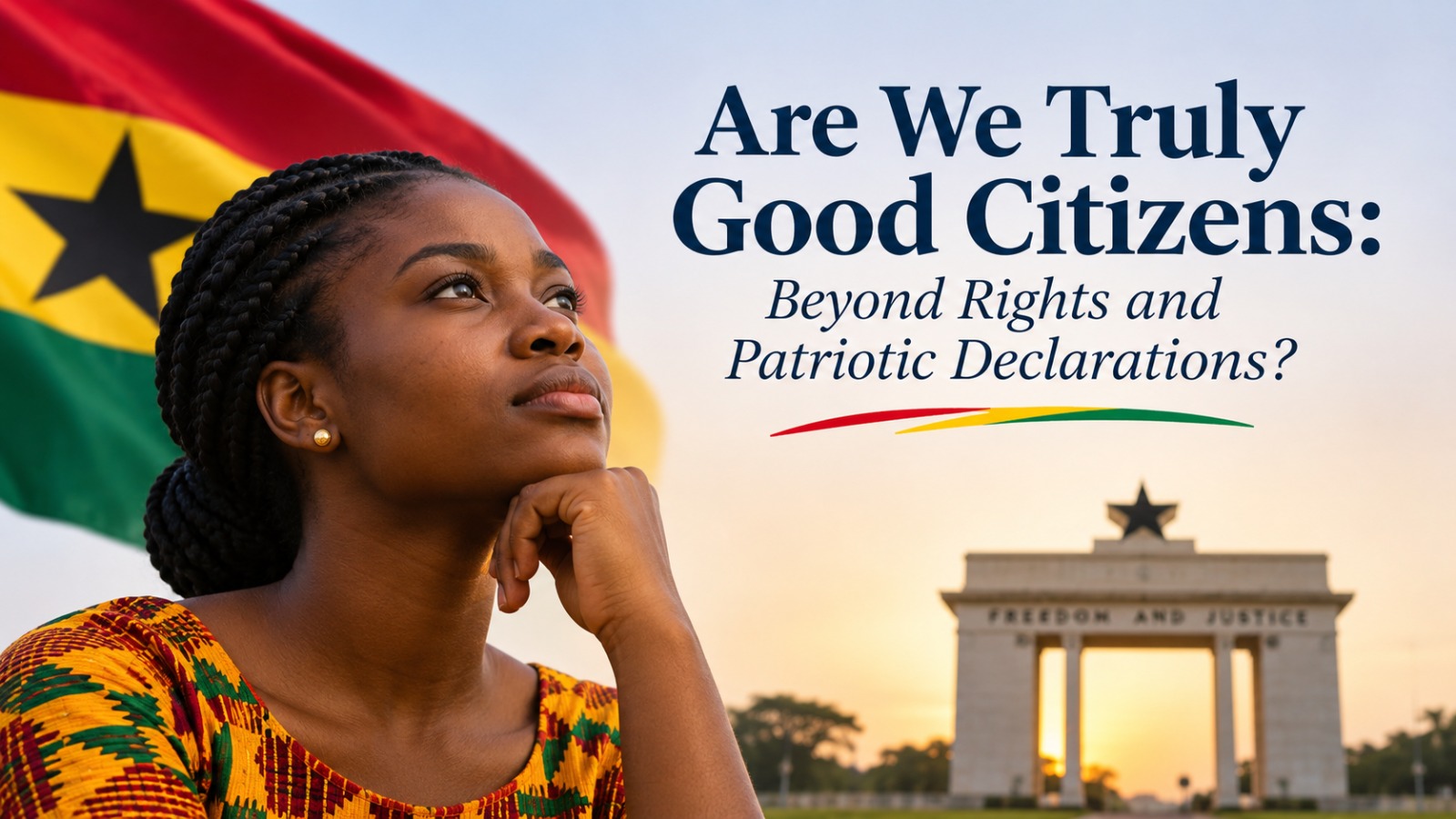
Citizenship is not exhausted by possessing a Ghana Card, holding a passport or making patriotic declarations. It is a relationship between the individual and the State, sustained by rights, responsibilities and a commitment to the common good. Article 41 of Ghana's 1992 Constitution outlines eleven duties of a citizen, reminding us that the enjoyment of rights and freedoms is inseparable from the performance of duties and obligations. Together, these provisions challenge the comfortable assumption that nation-building is principally the responsibility of politicians and public institutions. A country's character is also shaped by the everyday decisions of its citizens, particularly when nobody is watching.
Patriotism Beyond Words
Ghanaians readily demonstrate their national pride during sporting victories, independence celebrations and other occasions of national significance. But what happens to that patriotism when the celebrations end? Article 41(a) requires citizens to promote Ghana's prestige and good name and respect its national symbols, while Article 41(b) calls on them to uphold and defend the Constitution and the law. These responsibilities suggest that patriotism cannot be measured solely by emotional attachment to the nation. It must also find expression in integrity, discipline and respect for constitutional principles.
Consider the contradiction of proudly celebrating Ghana while offering a bribe to escape a lawful obligation, or demanding justice while seeking preferential treatment for ourselves. Can we genuinely claim to love our country while engaging in conduct that undermines its institutions? True patriotism requires us to recognise that the laws protecting society must also apply to us, even when compliance comes at a personal cost.
Equally important are the obligations under Articles 41(c) and 41(d), which emphasise national unity, harmonious coexistence and respect for the rights, freedoms and legitimate interests of others. Ghana's ethnic, religious and political diversity should enrich our national identity rather than become a source of hostility. This responsibility extends to our behaviour on social media, where unverified information, inflammatory commentary and personal attacks can undermine public trust and social cohesion. Freedom of expression is essential to democracy, but it must be exercised with due regard for the rights and dignity of others. A society cannot claim to value national unity while normalising intolerance towards those who think, worship or vote differently.
The Responsibilities We Often Neglect
Perhaps one of the greatest contradictions in our national life is our attitude towards corruption. We condemn it when public officials are accused of wrongdoing, yet sometimes rationalise dishonest practices when they benefit us or those close to us. Article 41(f) requires citizens to protect and preserve public property and expose and combat the misuse and waste of public funds and property. This duty raises an uncomfortable question: If we know about suspected corruption but deliberately remain silent, how different is our commitment to accountability from that of those we criticise?
Reporting suspected wrongdoing may involve genuine risks, including victimisation and retaliation. Public institutions must therefore provide credible and secure mechanisms that protect people who report concerns in good faith. Nevertheless, where safe and lawful reporting channels exist, personal loyalties, political affiliations and convenience should not determine whether we act. Accountability loses its meaning when we demand it from opponents but excuse wrongdoing among our associates.
The Constitution also connects national development to personal diligence and economic honesty. Article 41(e) requires citizens to work conscientiously in their lawfully chosen occupations, while Article 41(j) obliges them to declare their income honestly to the appropriate lawful agencies and fulfil their tax obligations. A teacher who neglects instructional duties, a public officer who misuses working hours or a businessperson who deliberately evades lawful taxes contributes, in different ways, to weakening the systems upon which society depends. We cannot consistently demand efficient public services while disregarding our own contribution to their effective functioning.
Our treatment of shared resources exposes another failure of civic responsibility. We may protect our personal possessions while remaining indifferent to damaged public school furniture, hospital equipment or neglected communal facilities. Article 41(g) requires citizens to contribute to the well-being of their communities, while Article 41(k) obliges them to protect and safeguard the environment. A public facility is not ownerless simply because it belongs to everyone. When shared spaces and resources deteriorate, the cost falls on the whole community, often most heavily on those least able to bear it.
Community participation, responsible waste management and care for public facilities are therefore not incidental gestures of goodwill. They are ways of recognising that our decisions affect the welfare of others, including generations yet unborn.
Articles 41(h) and 41(i) further require citizens to defend Ghana, render national service when necessary and cooperate with lawful agencies in maintaining law and order. These duties reinforce the principle that national security, peace and social stability depend on public cooperation. Such cooperation must, however, remain consistent with constitutional rights and the rule of law. Responsible citizenship requires neither unquestioning obedience nor indifference to authority, but a principled commitment to a society governed by law.
What Do We Owe Ghana?
It would be mistaken to suggest that responsible citizenship requires people to remain silent about the failures of government. Citizens have every right to demand accountable leadership, transparent institutions, equitable opportunities and effective public services. Indeed, the willingness to question the exercise of public power through lawful and democratic means is itself an important expression of citizenship.
Yet recognising government failures does not relieve citizens of constitutional responsibilities, just as individual goodwill cannot replace effective public institutions. The quality of our democracy depends on both sides of this relationship: the State must exercise authority lawfully and accountably, while citizens must act responsibly and remain willing to scrutinise power. Neither responsibility can serve as an excuse for abandoning the other.
Every Ghanaian has a responsibility to reflect on the duties prescribed under Article 41 of the 1992 Constitution and make a conscious effort to practise them. Understanding constitutional provisions is important, but knowledge alone does not produce responsible citizens. The true value of civic education becomes evident when constitutional principles influence our decisions, challenge our prejudices and guide our conduct, especially when doing what is right demands personal sacrifice.
Perhaps the deeper challenge confronting our citizenship is not ignorance of our constitutional obligations, but our tendency to treat those obligations as optional whenever fulfilling them becomes inconvenient. Citizenship acquires moral significance when personal advantage yields to public responsibility, when loyalty does not become an excuse for wrongdoing, and when commitment to the common good endures even without recognition or reward. The Constitution may articulate the ideals upon which Ghana should be built, but the conduct of citizens and public institutions ultimately determines whether those ideals become a lived reality.
Ultimately, being a good citizen is not about how loudly we proclaim our love for Ghana, but how consistently we demonstrate that love through our actions.
Before asking what Ghana has failed to do for us, we should also ask: what have we refused to do for Ghana? After all, what we expect from our country and what we contribute to its development must go hand in hand.
God bless our Homeland, Ghana
Communications and Corporate Affairs Department, NCCE, Accra
_
Follow us on our social media pages for more stories and posts from the NCCE.

https://www.instagram.com/nccegh/

https://www.facebook.com/nccegh/
https://www.youtube.com/channel/UCwajFJmmlmzRf1OMM.
Leave a comment